













Feature Wiki
Tabs
Adaptive Learning Paths: Learning Analytics
Page Overview
[Hide]- 1 Initial Problem
- 2 Conceptual Summary
- 3 User Interface Modifications
- 4 Additional Information
- 4.1 Involved Authorities
- 4.2 Technical Aspects
- 4.3 Privacy
- 4.4 Security
- 4.5 Contact
- 4.6 Funding
- 5 Discussion
- 6 Implementation
- 6.1 Description and Screenshots
- 6.2 Test Cases
- 6.3 Privacy
- 6.4 Approval
1 Initial Problem
Administrators and tutors currently lack specialized tools for managing complex, non-linear learning sequences. The biggest gap lies in evaluation: once a sequence is in use, there is no view showing how learners actually navigate through it.
These numbers are not available for an object within a learning sequence:
- Number of accesses
- Number of attempts
- Number of users who have completed, failed, not started, or are currently working on it, based on learning progress
- Failure rate (percentage)
- Number of users currently in the object
- Average rating and number of ratings
The same gap exists for the individual user:
- Number of objects visited, started, completed, and failed
- The object currently being accessed, with a link (if available)
- The path traversed so far
Without these numbers, a tutor cannot determine whether an adaptive branch is fulfilling its purpose. A branch that no one reaches and a branch where everyone fails look the same from the outside.
Moreover, it is not immediately apparent whether a learning sequence actually works. Dead ends—objects that lead nowhere—and flawed learning paths remain invisible until a learner reports being stuck.
2 Conceptual Summary
The tutor's management interface and introduces basic learning analytics for adaptive paths. Key features include:
- Dead End Detection: Automatic identification of objects that lack outgoing conditions or do not lead to a sequence exit. These are displayed in the object table.
- Entry and Exit Point Definition: Explicitly defining which object(s) serve as the starting point and which indicate the successful completion of the sequence.
- Online Status Validation: The Learning Sequence Object (LSO) cannot be set to "Online" if:
- No start object is defined.
- At least one unintended dead end exists (unless marked as an optional end-node).
- Learning Behavior Analytics:
- Frequency: Tracking how often each object is accessed.
- Success Rate: Tracking how often users fail or pass specific objects/conditions.
Learning Analytics
A new "Statistics" tab is created. It includes the sub-tabs "Objects" and "User". The "User" tab is hidden if data anonymization is enabled in the global learning progress settings.

"Objects"-Tab: The tab contains a table with the following values:
- Number of visits
- Number of attempts
- Number of users who based on LP have completed, failed, did not start, or are currently working on (for each)
- Failure rate (percentage)
- Number of users currently in the object
- Average rating and number of ratings per object

Actions and Bulk Actions include export of statistics.
"User"-Tab: The tab contains a table with the following values:
- Number of objects visited, started, completed, and failed
- Current object where the user is located (with a link, if applicable)
- Current path
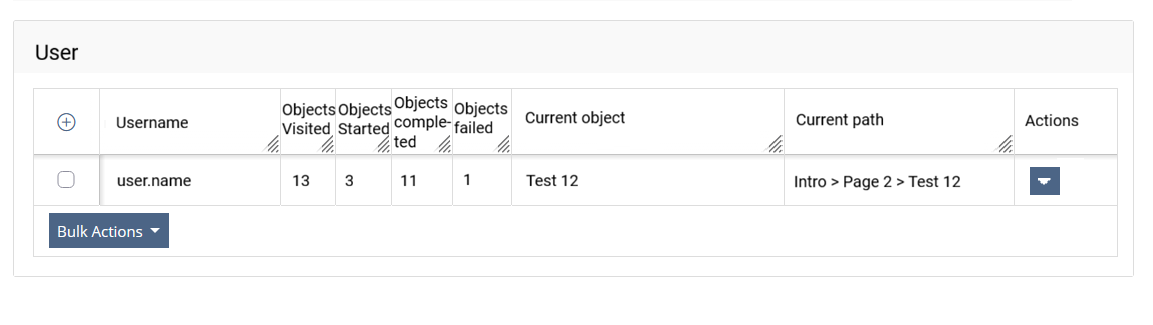
Actions and Bulk Actions include export of statistics.
3 User Interface Modifications
3.1 List of Affected Views
- LSO > Manage
- LSO > New "Statistics"-Tab
3.2 User Interface Details
- Validation Feedback: Clear error messages in the Settings tab explaining why the LSO cannot be set online.
- New Statistics Tab: As mentioned in 2.
3.3 New User Interface Concepts
No new UI concepts.
3.4 Accessibility Implications
The implementation utilizes Kitchen Sink elements to ensure accessibilty.
4 Additional Information
4.1 Involved Authorities
- Authority to Sign off on Conceptual Changes: Großkopf, Katrin [katrin.grosskopf]
- Authority to Sign off Code Changes: Clausen, Keven [keven.clausen], Großkopf, Katrin [katrin.grosskopf], Auerbach, Jeanine [jeanine.auerbach]
4.2 Technical Aspects
- Implementation of a graph traversal algorithm to detect unreachable nodes or nodes without exits (Dead Ends).
- Extension of the persistence layer to store analytics data (counters for access and failure).
- Integration of validation logic into the status-change workflow.
4.3 Privacy
Learning progress data is processed to evaluate the conditions. No new categories of personal data are introduced.
4.4 Security
No special security-relevant changes beyond the standard.
4.5 Contact
Person to be contacted in case of questions about the feature or for funding offers: Auerbach, Jeanine [jeanine.auerbach], Clausen, Keven [keven.clausen]
4.6 Funding
Funding status and funding parties are listed in the block 'Status of Feature' in the right column of this page.
If you are interested to give funding for this feature, please get into contact with the person mentioned above as 'Contact'.
5 Discussion
6 Implementation
Feature has been implemented by {Please add related profile link of this person}
6.1 Description and Screenshots
{ Description of the final implementation and screenshots if possible. }
6.2 Test Cases
Test cases completed at {date} by {user}
- {Test case number linked to Testrail} : {test case title}
6.3 Privacy
Information in privacy.md of component: updated at {date} by {user} | no change required
6.4 Approval
Approved at {date} by {user}.
Last edited: 9. Oct 2026, 07:24, Auerbach, Jeanine [jeanine.auerbach]