



















































Feature Wiki
Tabs
Undo in the ILIAS Page Editor
Page Overview
[Hide]- 1 Summary
- 2 Problem Statement
- 3 Concept
- 4 User Interface Modifications
- 4.1 List of Affected Views
- 4.2 User Interface Details
- 4.2.1 Undo control
- 4.2.2 Redo control - second stage only
- 4.2.3 Mockups
- 4.3 New User Interface Concepts
- 4.4 Accessibility Implications
- 5 Technical Information
- 6 Privacy
- 7 Security
- 8 Contact
- 8.1 Involved Authorities
- 8.2 Contact
- 9 Funding
- 10 Discussion
- 11 Implementation
1 Summary
Introduce an Undo button in the ILIAS Page Editor that allows users to reverse their most recent saved change using the existing history. As a first implementation, the feature provides a single undo step without requiring users to open the history and restore a previous version manually.
A separate, more ambitious second stage would fundamentally revise the history mechanism to support multiple undo and redo steps.
2 Problem Statement
Users need a straightforward way to recover from accidental changes while editing a page. Deleting content, moving an element to the wrong position or applying an unintended change should not require a separate version-restoration workflow.
The existing history is the current basis for this recovery, but accessing the history, identifying the appropriate version and restoring it interrupts the editing process. Users must also understand the relationship between their latest action and the available page versions.
Two related needs should be distinguished:
- Immediate recovery: undo the most recent saved change directly in the Page Editor.
- Flexible revision: move backwards and forwards through several editing steps, including restoring changes that have previously been undone.
The first need should be addressed independently of the second.
A comprehensive undo and redo mechanism would require a more fundamental revision of how editing steps and page history interact and should not delay the initial improvement.
3 Concept
3.1 Initial implementation: undo the most recent saved change
An “Undo” button is added to the Page Editor. It restores the page state immediately preceding the user’s most recent saved change, using the existing page history as its data source.
For this implementation, an undoable step is defined as a saved page change for which the history contains the preceding page state. It is not an individual keystroke or an unsaved change within an open input field. The feature therefore provides page-level recovery rather than replacing any local undo functionality available while editing text.
The user activates “Undo” without leaving the page editor. ILIAS restores the preceding page state and updates the editing view accordingly. No selection of a historical version is required.
The first implementation provides one undo step only:
- After an eligible saved change, “Undo” becomes available
- After that change has been undone, the button becomes unavailable
- After a subsequent eligible saved change, “Undo” becomes available again for that new change
- Repeated activation must not alternate between the original and restored versions or inadvertently provide unrestricted navigation through the history
The restoration must preserve the history rather than delete the change being undone. Users can still use the existing history workflow to inspect or restore available versions. A dedicated “Redo” button is not part of this first implementation.
The feature is available only where the history provides a reliable preceding page state and the user has the necessary editing permissions. It must not silently enable page history where it is disabled or bypass existing retention settings.
3.2 Follow-up development: multi-step undo and redo
The second stage introduces a sequence of undoable editing steps and a current position within that sequence.
“Undo” moves to the preceding state; “Redo” reapplies the next previously undone step. Several consecutive changes can therefore be undone and subsequently restored.
If a user makes a new change after undoing earlier steps, the previous redo sequence is no longer available through “Redo”. This does not necessarily mean that historical versions are deleted: the long-term page history and the active undo/redo sequence must be treated as distinct concepts.
This stage requires a fundamental revision of the history mechanism. In particular, it must define:
- Which editing operations form one undoable step
- Whether undo and redo state belongs to a page, a user or an editing session
- How simultaneous editing and changes from multiple browser tabs are handled
- How page elements and their referenced resources remain recoverable
- How retention settings affect the availability of undo and redo steps
These decisions require a separate, detailed concept before the second stage can be approved for implementation. Approval of the initial single-step feature should not imply approval of this broader redesign.
4 User Interface Modifications
4.1 List of Affected Views
- ILIAS page editor / Slate
4.2 User Interface Details
4.2.1 Undo control
- Label: “Undo”
- Placement: in the editor’s persistent slate action area, accessible without opening the history
- Behaviour: restores the page state preceding the latest eligible saved change and refreshes the affected editing content
- Availability: inactive when no eligible undo step exists
- During execution: further activation is prevented until the operation has finished
The reason for unavailability must be communicated accessibly, for example:
- “There is no change to undo.”
An inactive control must not rely exclusively on a tooltip to explain its state.
4.2.2 Redo control - second stage only
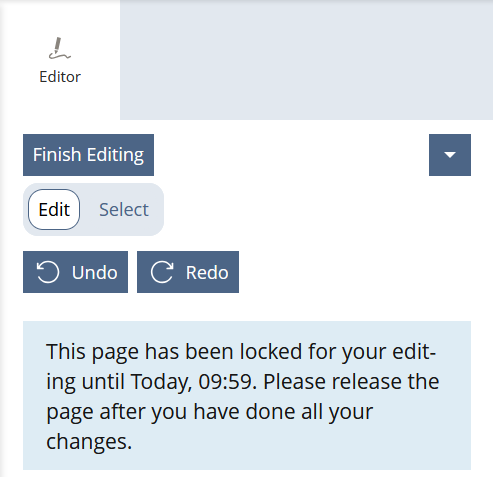
- Label: “Redo”
- Placement: next to “Undo”
- Behaviour: reapplies the next previously undone step
- Availability: inactive when no redo step exists
4.2.3 Mockups
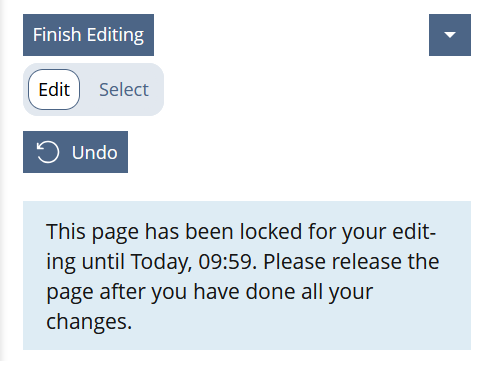
This mockup shows the Undo button displayed as a standard button.
This mockup shows the Undo and Redo buttons displayed as standard buttons.
4.3 New User Interface Concepts
No new UI concept is proposed for the initial implementation. The feature should use existing ILIAS button, status and feedback components.
Any history menu, selectable list of undo steps or preview of a restoration would extend the scope and require separate specification.
4.4 Accessibility Implications
The feature must be operable by keyboard and expose meaningful accessible names and states.
Particular attention is required where restoration refreshes or replaces editor content:
- Focus must remain in a predictable location. If the focused element is removed, focus must move to a meaningful editor control
- Success, failure and conflict messages must be available to assistive technologies without requiring users to find them visually
- Availability and processing states must not be communicated through colour alone
- Reasons why undo is unavailable must be accessible without hovering
- Any refresh must preserve a usable navigation and focus sequence
No new global keyboard shortcuts are proposed for the initial implementation. This avoids introducing unspecified conflicts with text editing, browser behaviour or assistive technologies.
5 Technical Information
The implementation involves the shared Page Editor, its page-history mechanism and the host components exposing the editor.
The following requirements must be verified:
- Version granularity: establish which saved operations produce a recoverable preceding page state
- Complete restoration: restore page content and structure consistently, including the references needed by restored elements
- Atomicity: either complete the restoration or leave the current page unchanged
- Conflict detection: validate the current page version immediately before restoration
- Undo eligibility: distinguish a new user edit from a restoration so that the single-step button does not become a toggle between versions
- Retention: respect existing history configuration and cleanup rules
- Performance: avoid loading the full page history merely to determine whether “Undo” is available
6 Privacy
The proposal must be checked against the relevant component’s existing PRIVACY.md.
The initial implementation should reuse existing historical data wherever possible. It does not propose additional analytics, extended retention periods or a separate permanent record of users’ undo actions.
7 Security
Undo changes stored page content and must receive the same server-side authorization and request protection as other editing operations.
The implementation must prevent unauthorized restoration, access to historical content without the necessary permissions and overwriting of newer page states through stale requests.
Whether the feature requires a new endpoint or can reuse an existing restoration action remains a technical implementation decision.
8 Contact
8.1 Involved Authorities
- Authority to Sign off on Conceptual Changes: Killing, Alexander [alex]
- Authority to Sign off Code Changes: Killing, Alexander [alex]
8.2 Contact
Person to be contacted in case of questions about the feature or for funding offers: Becker, Matthias [matthias.becker]
9 Funding
- …
10 Discussion
Kunkel, Matthias [mkunkel], 11 NOV 2026: This is a very good suggestion to improve the editor's usability. Thanks. Just an aesthetical question: can we place the 'Undo' button next to the 'Finish Editing' button to have all buttons in one row? Presenting a button above and below the view control looks a bit odd.
Becker, Matthias [matthias.becker], 16 NOV 2026: @Matthias, your suggestion is fine by me. I did it this way because of visual comprehension hierarchy. So that "Edit" precedes "Undo" hierarchically from top-down. I think some quick testing could determine whatever users would understand and deem more intuitive. I don't really have a preference as I also see value in your proposal.
JourFixe, ILIAS [jourfixe], 16 NOV 2026: We highly appreciate this suggestion and accept it for trunk. We see the main advantage of this feature in a simple way to undo one change in the page editing. So we would like only that the implementation of the Undo button is realised (chap. 3.1). The suggestion of a redo and multiple undoes should be discussed in a separate feature requests as several conceptual questions have to be answered there first. To avoid misunderstandings, the title of this FR is changed to "Undo in the ILIAS Page Editor".
11 Implementation
{ The maintainer has to give a description of the final implementation and add screenshots if possible. }
Test Cases
- {Test case number linked to Testrail} : {test case title}
Privacy
Information in privacy.md of component: updated on {date} by {user} | no change required
Approval
Approved at {date} by {user}.
Last edited: Yesterday, 15:50, Strassner, Denis [dstrassner]